
Adding AI co-scientists
Teams of AI agents now read the literature, propose hypotheses, write and run the analysis, and design the next experiment, faster than a laboratory of people can. We are building the lab around them: agents do the work in the middle, a scientist decides what to test and verifies what comes back, and everyone trained here learns to work this way. What agents cannot do is measure, and that is the other half of the plan.
Fleets of agents, one human judgment
The model comes from James Zou's group in Stanford Biomedical Data Science. In their Virtual Lab, an AI "principal investigator" recruits specialist agents, immunology, computational biology, machine learning, holds meetings with them, and hands the human team a research plan. Set loose on a COVID-19 problem, the agents designed 92 candidate nanobodies in days; two bound new variants in the wet lab. A "devil's advocate" agent argues against the others, and a human expert reviews every design before anything is synthesized.
The same group then scaled the idea to a virtual biotech company of 37,000 agents organized into departments. In under a day, at a computing cost of about $46, the agents read the literature on the lung-cancer target B7-H3, ran their own single-cell analyses, and recommended a drug design. Weeks later a pharmaceutical company reported promising trial results with the same approach, which the agents could not have known about.
Every one of these systems reasons over data someone else measured. That is the constraint, and it is where we work. An agent cannot put cells isolated from a patient sample on a sequencer, and it cannot see what the assay cannot see. The genome, transcriptome, and methylome of a single cell, read together from cells that survived a child's chemotherapy, is a measurement that did not exist when today's models were trained. Better measurement is what turns a clever agent into a correct one.
"It really does feel like a new era where one person plus a bunch of GPT or Claude models can really make significant, fast progress in drug discovery."Kyle Swanson, formerly of the Zou lab, in The New York Times, September 17, 2026
"By turning static papers into interactive AI agents, Paper2Agent introduces a paradigm for knowledge dissemination and a collaborative ecosystem of AI co-scientists."Miao, Davis, et al., Nature, September 16, 2026
The co-scientist loop, built around cells isolated from patient samples
Every cycle starts and ends with a human. The middle, where most of the time used to go, is where the agents work.
Three things already true in the lab
We build the measurements the models are missing
PTA gave single cells an accurate genome. Same-cell transcriptome and methylation readouts followed, and surface proteins are next. Each new layer is a kind of data that was not available when current foundation models were trained, and each one changes what they can get right.
We collaborate with agents on our analysis code
Our variant-calling, phylogeny, and figure pipelines are now built in collaboration with coding agents and reviewed by the scientists who own the question. The rule is simple: an agent can propose and run anything, and a human checks the denominator before a number leaves the lab.
Our data is built to train and test the models
Same-cell genome, transcriptome, and methylation from thousands of primary human cells is exactly the training and ground-truth data that DNA and single-cell foundation models lack. We are generating it at scale and preparing it so that models such as AlphaGenome can be fine-tuned and tested against cells from real patients. Our papers will ship as agents, so a method can be used the day it is published.
Built with Claude
Our analysis pipelines, figures, and this website are built in collaboration with Claude and Claude Code, with the lab's scientists reviewing every result. We also use the open models and agent toolkits listed on the Resources page.



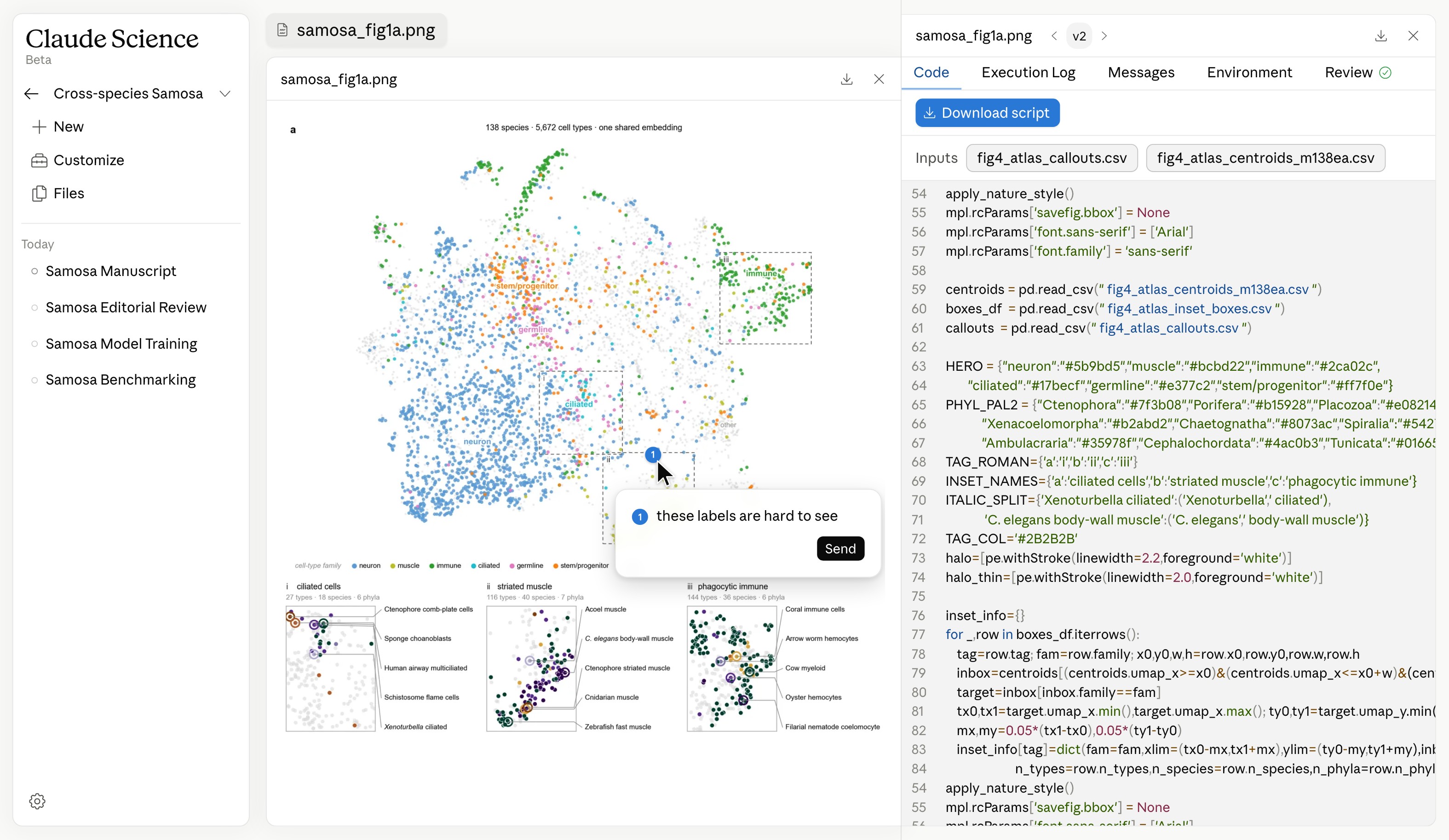
Everyone is building the agent. Few are building the measurement.
The same idea is arriving from several directions at once, and they share a division of labor: agents generate, critique, and analyze; humans choose, measure, and verify. They also share a dependence. Each is only as good as the data it was trained on and handed.
AI co-scientist
A Gemini-based team of agents that generates hypotheses, debates them in self-play, and ranks them in tournaments. Proposed drug-repurposing candidates for acute myeloid leukemia that were then confirmed in the wet lab, and independently rediscovered a mechanism of bacterial gene transfer that an Imperial College group had found but not yet published.
Virtual Lab and the virtual biotech
An AI principal investigator recruits specialist agents and holds meetings; a devil's-advocate agent attacks every claim; a human expert reviews before anything is made. Scaled to 37,000 agents, the system proposed a lung-cancer drug design that industry later matched, in under a day for about $46.
Robin and Kosmos
Robin generated the hypotheses, designed the experiments, analyzed the data, and drafted the figures that identified a glaucoma drug as a candidate for dry macular degeneration; humans ran only the physical experiments. Its successor, Kosmos, reads about 1,500 papers and writes tens of thousands of lines of analysis code in a single run.
Claude for Life Sciences and Claude Science
An AI workbench that connects agents to genomics and structure models such as Evo 2 and Boltz-2, includes a reviewer agent that checks citations and calculations, and is being wired to microscopes and liquid handlers at Janelia and Genentech. Partnerships with the Allen Institute and HHMI focus on the months of routine analysis between experiments.
The virtual cell
Foundation models trained on hundreds of millions of cells to predict how a cell responds to a perturbation before the experiment is run, with an annual public challenge. Models like this are only as good as the ground-truth single-cell data they are tested against.
The measurement lab for the agent era
We take these tools as given and build what they lack: new ways to measure single cells from patients, data that postdates their training sets, a clinic that supplies the question, a scientist who verifies every result before it acts on a child, and a training program that teaches the next generation to run research this way.
The new way of doing science needs new ways of measuring
In the space of eighteen months, the pieces of an AI co-scientist lab went from demonstration to routine. Coding agents now build and debug analysis pipelines from a sentence of intent. Agent teams with distinct personas hold meetings and design molecules. Papers can be converted automatically into agents that expose their code, data, and workflows through a standard protocol, so that a method from another lab becomes a tool ours can call in plain language. Genome foundation models can predict the effect of a noncoding variant, the exact class of mutation our leukemia work turns up in individual cells.
What has not arrived, and will not arrive from a data center, is new measurement. Every model above was trained on data that already existed, much of it bulk measurement that averages across cells, and every agent is bounded by the data it can reason over. A laboratory that invents measurements and knows the clinical question behind each one is where these tools have the most to work with.
Sources: Swanson et al., Nature 2025 (Virtual Lab); Miao et al., Nature 2026 (Paper2Agent); Zou and Zhang, Science 2026 (virtual biotech); Google Research, 2025 (AI co-scientist); FutureHouse (Robin) and Kosmos; Anthropic, 2026 (Claude Science); Arc Institute Virtual Cell Challenge; Sakana AI Scientist, Nature 2026; Nature editorial on AI scientists, 2026; reporting in The New York Times and Stanford Medicine News, September 2026.
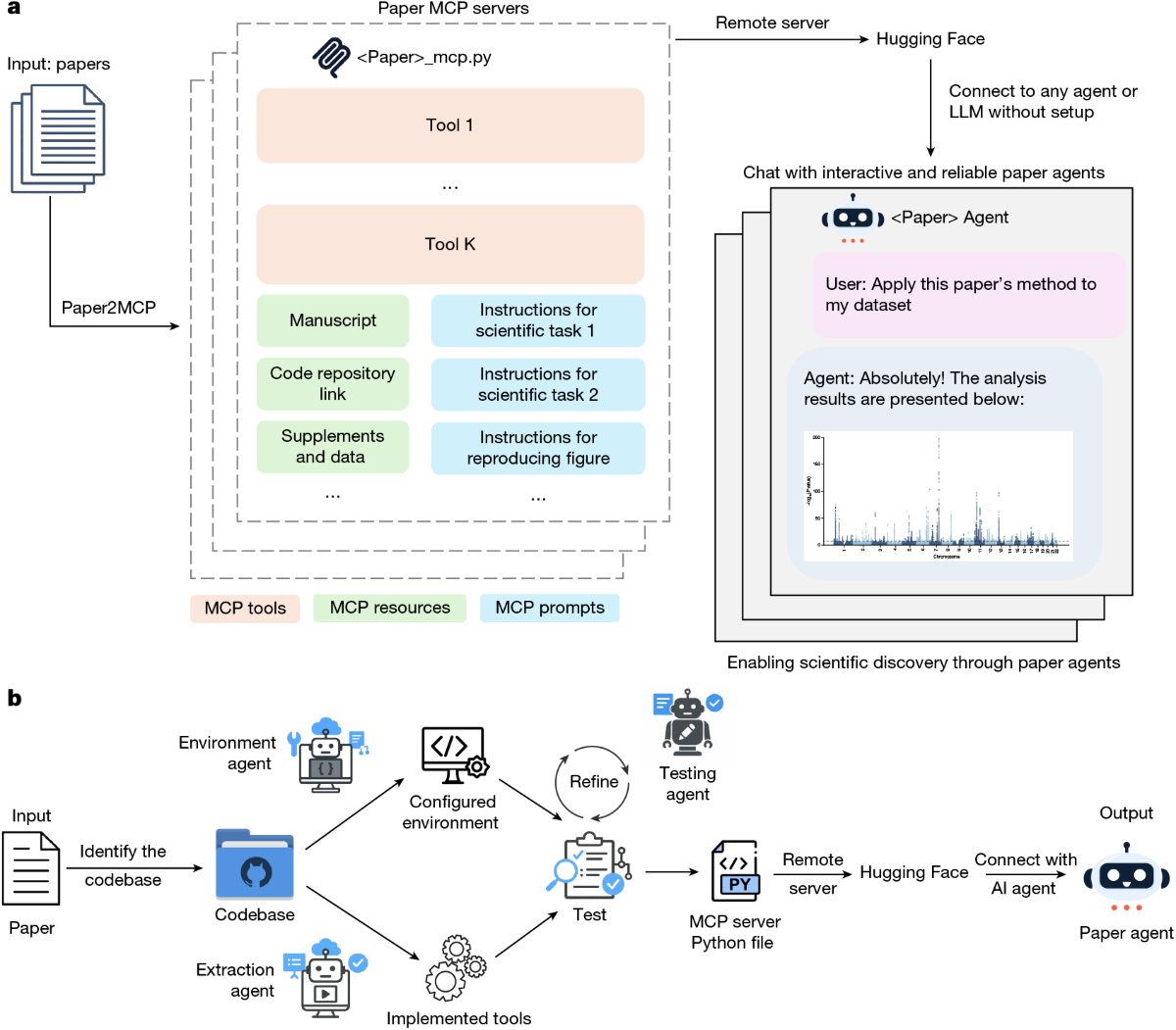
Paper2Agent turns a research paper into an AI agent that can apply the paper's methods to a reader's data. Figure 1 from Miao, Davis, et al., Nature 2026, reproduced under CC BY-NC-ND 4.0.
A place to learn how to run a lab this way
We expect the scientists leading biomedical research in ten years to direct teams of agents the way today's investigators direct teams of people, and they will know that the agents are only as good as the measurements they are given. Few training programs teach both. We are making it part of training in the lab, for postdocs, students, and visiting clinicians: how to invent a measurement, and how to put agents to work on it.
Trainees leave able to do four things: frame a clinical question so that agents can work on it, produce single-cell data that is not in any training set, run and supervise an agent team through analysis and hypothesis generation, and verify the output rigorously enough to publish it or act on it for a patient.
What a trainee learns
- The question. Shadow the clinic. Turn a relapse, a resistant clone, or an undiagnosed child into a testable question with a measurable answer.
- The measurement. Run PTA and same-cell multiomics on primary human cells. Know what the data can and cannot say.
- The agent team. Set up coding and analysis agents, give them the data and the literature, assign a devil's advocate, and direct the meetings.
- The verification. Positive controls, held-out cells, orthogonal assays. Learn the failure modes of agents on genomic data and how to catch them.
- The release. Publish the method with its agent, so the next lab can use it the same day.
Help build the co-scientist lab
The agents are here. The measurements that will make them right still have to be invented. We are recruiting people who want to do that, and partners who want to fund it. If you are a chemist, an engineer, a computational biologist, a clinician, or a donor who sees the same future, write to us.